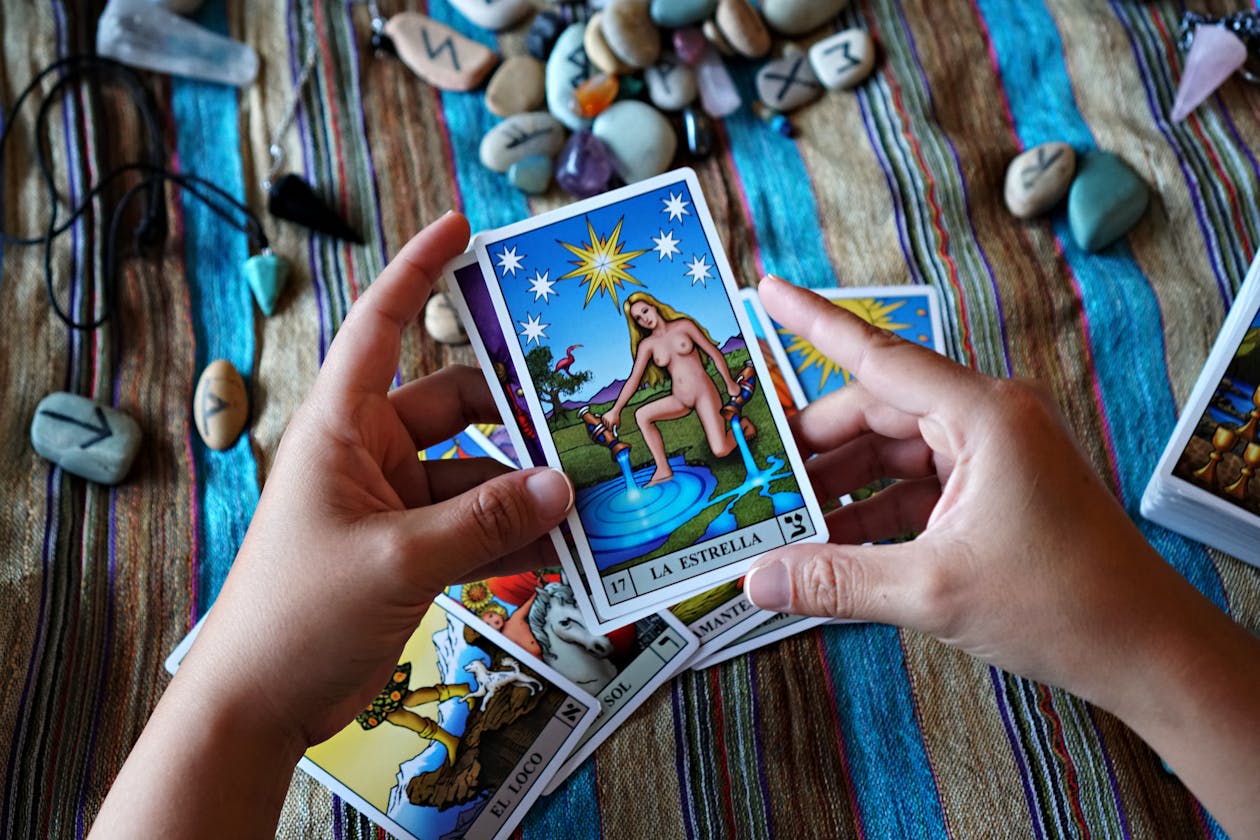
- Tarot archetypes represent 22 universal human patterns — from the Fool’s innocence to the World’s wholeness — that mirror the stages every person encounters on the journey of psychological growth.
- Carl Jung’s concept of the collective unconscious provides the psychological foundation for understanding why tarot imagery resonates across cultures, showing that these symbols are hardwired into the human psyche rather than learned.
- According to Verified Market Reports’ 2024 market analysis, the global tarot cards market is valued at approximately $600 million and projected to reach $1.2 billion by 2033, reflecting a surge in people seeking archetypal self-reflection tools.
- The Shadow archetype, embodied in cards like The Moon and The Devil, represents the repressed aspects of the self that must be confronted for genuine personal growth — a concept central to Jungian individuation.
- Modern neuroscience research using fMRI has shown that tarot reading activates the brain’s default mode network, the same regions associated with introspection and self-referential thinking.

Introduction
Shuffle a tarot deck and you hold 78 cards that have survived six centuries of human history — not because they predict the future, but because they reflect something universal about the people who hold them. The images on those cards are not random illustrations. They are archetypes: deep, recurring patterns of human experience that show up in myths, dreams, and stories across every culture on Earth. Understanding tarot archetypes means understanding yourself.
Most people encounter tarot through the lens of fortune-telling — a circus act, a party trick, a mystical prediction. That framing misses the real power of the deck. Beneath the surface of divination lies a sophisticated system of psychological symbolism, one that Carl Jung himself recognized as a mirror of the collective unconscious. The tarot does not tell you what will happen. It tells you where you are in the universal human story through the language of tarot archetypes.
In this article, we will explore how tarot archetypes map to the deepest patterns of human psychology, trace the connection between the Major Arcana and Jung’s theory of the collective unconscious, examine what modern neuroscience reveals about why tarot archetypes trigger introspection, and offer practical ways to work with tarot archetypes for genuine self-understanding.
What Are Tarot Archetypes? Understanding the Universal Language
Archetypes Defined: Patterns Older Than Language
Tarot archetypes are the recurring symbolic figures embedded in the 78-card tarot deck that represent fundamental human experiences, motivations, and psychological states. Every card — from the carefree Fool to the triumphant World — embodies a universal pattern that transcends culture, language, and era. The study of tarot archetypes is, at its core, the study of what it means to be human.
The term “archetype” comes from the Greek archetypon, meaning “original pattern.” Carl Jung formalized the concept in the early 20th century, describing archetypes as innate, universal prototypes for ideas and images that reside in what he called the collective unconscious. As Jung wrote in his Collected Works, Volume 9i: The Archetypes of the Collective Unconscious, an archetype is “a tendency to form representations of a motif — representations that can vary a great deal in detail without losing their basic pattern.”
In the context of tarot, this means that the figure of the Empress does not merely represent “a mother.” She represents the Mother — the nurturing, creative, life-giving force that appears in every culture as Durga, Gaia, Hathor, Mary, and countless others. The specific image changes, but the underlying pattern remains constant. This is the defining characteristic of tarot archetypes — they are simultaneously specific and universal.
The Collective Unconscious and Why Tarot Archetypes Resonate
Jung proposed that beneath the personal unconscious — the repository of your individual memories and experiences — lies a deeper layer he called the collective unconscious. This is the shared psychological inheritance of all humanity, containing the archetypal patterns that shape how we perceive the world, tell stories, and make meaning.
The tarot deck, with its roots in 15th-century Italy, evolved over centuries into a remarkably complete visual representation of these archetypal patterns. The 22 cards of the Major Arcana trace what Jung would later call the process of individuation: the psychological journey from unconscious wholeness (the Fool) through fragmentation, struggle, and integration, back to conscious wholeness (the World).
This is why tarot imagery feels familiar even to first-time viewers. You do not need to study the cards to recognize that the Hermit carries the energy of solitude and wisdom, or that the Tower represents violent, necessary upheaval. These patterns are already inside you, as Jung would argue — the cards simply give them a face. This immediacy of recognition is what makes tarot archetypes such a powerful tool for psychological insight. As explored in our article on Dean Radin and the science of magic, the boundary between mystical experience and measurable psychological phenomena is far thinner than most people assume.
Carl Jung and the Tarot Connection
Jung’s 12 Archetypes and Their Tarot Counterparts
Carl Jung identified twelve primary archetypes that symbolize fundamental human motivations and social roles. While Jung never wrote about tarot directly, his framework maps onto the tarot archetypes with striking precision. The following alignment between Jungian theory and tarot archetypes reveals how deeply interconnected these systems of understanding truly are. Here is how the key Jungian archetypes align with the Major Arcana:
- The Self — The World (wholeness, integration of all parts) and The Fool (original, unfragmented consciousness)
- The Shadow — The Moon (hidden fears, the unknown) and The Devil (bondage, repressed desires)
- The Anima — The Empress (nurturing feminine), The High Priestess (intuitive wisdom), Strength (inner fortitude)
- The Animus — The Emperor (structuring masculine), The Hierophant (spiritual authority), The Hermit (inner guidance)
- The Persona — The Magician (the face we show the world, mastery of perception)
- The Hero — The Chariot (triumph over obstacles, willpower in action)
- The Child — The Fool (innocence, new beginnings, the空白 canvas of potential)
- The Wise Old Man — The Hermit (solitary wisdom, lantern-lit guidance)
- The Mother — The Empress (fertility, creation, unconditional nourishment)
- The Father — The Emperor (authority, discipline, protective structure)
- The Trickster — The Magician (cunning transformation, subversion of the expected)
- The Lover — The Lovers (passion, intimate connection, choice between paths)
Each card does not represent a single, fixed archetype. Instead, the tarot archetypes are layered — one card can express multiple archetypal energies depending on context, position in a spread, and the psychological state of the person reading it. The Empress can appear as the Mother, the Anima, or the Lover depending on what aspect of the psyche is being activated. This fluid quality is what makes tarot archetypes so rich for psychological exploration.
Synchronicity: Why the “Right” Tarot Archetype Appears
One of Jung’s most provocative contributions to the discussion of tarot is his concept of synchronicity — the idea that events can be meaningfully related without being causally connected. Jung introduced this concept in his 1952 work Synchronicity: An Acausal Connecting Principle, arguing that certain coincidences carry psychological significance that cannot be explained by conventional cause and effect.
In a tarot reading, synchronicity offers a framework for understanding why the “right” card seems to appear at the right moment. It is not magic in the supernatural sense. Rather, it is a meaningful coincidence between the internal psychological state of the querent and the external, random draw of the cards. The archetype on the card resonates because it mirrors something already active in the unconscious mind — the card gives shape to something formless.
Jung did not use tarot for fortune-telling. He appreciated it as a tool for symbolic self-reflection, one that could externalize the inner dynamics of the psyche and make them visible, discussable, and ultimately workable. The tarot archetypes, in this sense, are therapeutic instruments — not mystical predictions.
The 22 Major Arcana as Human Archetypes
The 22 tarot archetypes of the Major Arcana — the 22 trump cards of the tarot — form a complete narrative arc of human psychological development. Known as the Fool’s Journey, this sequence traces the path from unconscious innocence through struggle and transformation to conscious wholeness. Understanding the tarot archetypes in order reveals a coherent psychological narrative. Each grouping below represents a distinct phase of that journey.
The Journey Begins: The Fool to The Emperor (Archetypes of Identity)
The Fool (0) — The Eternal Child. Pure potential, reckless trust, the willingness to step off the cliff. The Fool is the psyche before it has been shaped by experience — whole, but unconsciously so.
The Magician (I) — The Persona and Trickster. The first card of conscious action. The Magician represents the ability to transform inner thoughts into outer reality, to shape perception, to take charge of one’s narrative. He is the architect of the face we present to the world.
The High Priestess (II) — The Anima as Wisdom. She sits at the threshold between the conscious and unconscious, guarding access to deeper knowing. The High Priestess represents intuition, hidden knowledge, and the passive, receptive mode of understanding.
The Empress (III) — The Mother Archetype. Fertility, creation, nurturing in its most expansive form. She is the life-giver — not just biological motherhood, but the creative force that brings ideas, relationships, and projects into being.
The Emperor (IV) — The Father Archetype. Structure, authority, discipline. Where the Empress nurtures, the Emperor builds systems. He represents the archetypal energy of protection through order, laws, and boundaries.
The Middle Path: The Hierophant to The Wheel of Fortune (Archetypes of Guidance and Change)
The Hierophant (V) — The Wise Old Man as Spiritual Teacher. Tradition, institutional knowledge, the transmission of cultural wisdom from one generation to the next. He represents the part of the psyche that seeks meaning through established frameworks.
The Lovers (VI) — The Lover Archetype. Not merely romantic love, but the archetypal energy of choice, duality, and union. The Lovers represent the moment of conscious decision — the point where you must choose one path and, in doing so, reject another.
The Chariot (VII) — The Hero in Motion. Willpower, determination, the triumph of directed effort over opposing forces. The Chariot is the archetype of the warrior who has harnessed internal contradictions and drives them toward a single goal.
Strength (VIII) — The Anima as Inner Power. Not physical force but moral courage, patience, and the taming of inner beasts through compassion rather than domination. Strength represents the psyche’s ability to integrate wild, instinctual energy.
The Hermit (IX) — The Wise Old Man as Inner Guide. Deliberate solitude, introspection, the lantern that illuminates the path within. The Hermit represents the archetypal energy of withdrawing from the world to find your own truth.
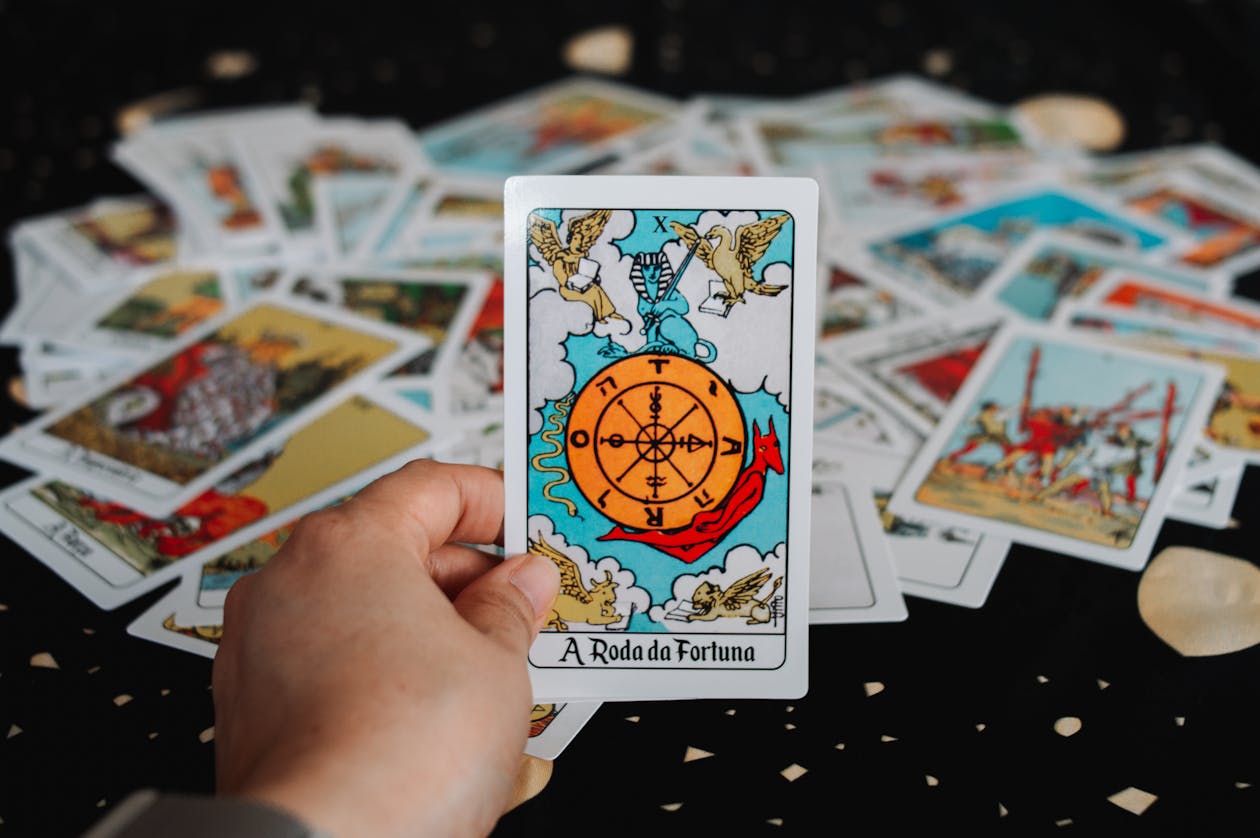
Wheel of Fortune (X) — The Archetype of Fate and Cycles. The turning point, the recognition that life operates in cycles beyond individual control. This card represents the ego’s confrontation with forces larger than itself.
The Inner Work: Justice to The Tower (Archetypes of Transformation)
Justice (XI) — The Archetype of Balance and Accountability. Cause and effect, the weighing of actions against consequences. Justice demands that the psyche take responsibility for what it has created.
The Hanged Man (XII) — The Archetype of Surrender. Voluntary suspension, seeing the world from an inverted perspective. The Hanged Man represents the psychological breakthrough that comes only when you stop struggling and allow a new viewpoint to emerge.
Death (XIII) — The Shadow of Mortality. Not physical death, but the archetypal energy of endings that make new beginnings possible. Death represents the psyche’s confrontation with impermanence — the shadow that follows every living thing and gives life its urgency.
Temperance (XIV) — The Archetype of Integration. Alchemy, blending, the patient work of combining opposites into something new. Temperance represents the psyche’s ability to hold contradiction without fragmentation.
The Devil (XV) — The Shadow in Full Force. Bondage, addiction, the chains of self-imposed limitation. The Devil represents the repressed desires and fears that control us precisely because we refuse to look at them.
The Tower (XVI) — The Archetype of Necessary Destruction. Violent upheaval, the shattering of false structures. The Tower is perhaps the most feared card in the deck, yet it represents an archetypal pattern that every human encounters: the moment when everything you built on a false foundation collapses, forcing you to rebuild on truth.
The Awakening: The Star to The World (Archetypes of Wholeness)
The Star (XVII) — The Archetype of Hope and Renewal. After the Tower’s destruction, the Star appears as the promise that regeneration is always possible. She represents the psyche’s capacity to find meaning and direction after devastation.
The Moon (XVIII) — The Shadow’s Final Test. Illusion, fear, the liminal space between unconsciousness and consciousness. The Moon represents the last confrontation with the unknown before full awakening — the archetypal “dark night of the soul” that mystics and psychologists alike describe.
The Sun (XIX) — The Child Archetype Reborn. Joy, clarity, the return of innocence — but now conscious rather than naive. The Sun represents the psyche that has passed through shadow and emerged into clear light.
Judgement (XX) — The Archetype of Reckoning and Rebirth. The final evaluation, the call to rise. Judgement represents the moment when the integrated self looks back on the entire journey and accepts every part — shadow and light, failure and triumph.
The World (XXI) — The Self, Realized. Completion, wholeness, the return to the unity that the Fool began with — but now earned through experience. The World is the archetype of individuation achieved: the psyche that has integrated all its parts and stands complete.
Key Statistics & Data
- According to Verified Market Reports’ 2024 market analysis, the global tarot cards market is valued at approximately $600 million and projected to reach $1.2 billion by 2033, growing at a compound annual growth rate (CAGR) of 8.5%.
- According to Technavio’s 2024-2029 forecast report, the tarot cards market will grow by $209.7 million between 2024 and 2029, with the Asia-Pacific region accounting for 54% of that growth.
- According to WiFi Talents’ 2024 industry statistics, male participation in the tarot market has increased by 10% since 2018, driven primarily by psychology-themed and archetype-focused tarot decks.
- According to Jung’s The Archetypes of the Collective Unconscious (Collected Works, Vol. 9i, 1959), archetypes are defined as “a tendency to form representations of a motif — representations that can vary a great deal in detail without losing their basic pattern.”
- According to a 2025 study published on ResearchGate titled “The Duality of Archetypes in Tarot Cards,” tarot symbolism employs both light and shadow aspects of Jungian archetypes, revealing the dual nature of human psychological patterns through the psychoanalytic paradigm.
The Shadow Self in Tarot: Facing What We Hide
The Moon, The Devil, and The Tower: Archetypes of Disruption
Of all the tarot archetypes, none are more misunderstood than the Shadow cards. These tarot archetypes — The Moon, The Devil, and The Tower — consistently provoke fear and anxiety in readings — yet they represent some of the most psychologically necessary archetypes in the entire deck.
The Shadow, as Jung defined it, is the part of the personality that the conscious ego refuses to acknowledge. It contains everything we have repressed, denied, or rejected about ourselves: anger, envy, fear, desire, vulnerability. The Shadow is not evil — it is simply the unlived life, the aspects of self that were too threatening or too painful to integrate.
The Moon is the Shadow as confusion and fear. It represents the psychological territory where nothing is clear, where old fears rise from the unconscious, and where the ego must navigate without its usual certainty. The Moon does not offer answers — it offers the archetypal experience of being lost, which is a prerequisite for being found.
The Devil is the Shadow as bondage. He represents the patterns that hold you captive — addiction, toxic relationships, self-sabotage, limiting beliefs. The Devil’s most insidious trick is convincing you that the chains are unbreakable. Look closely at most tarot depictions: the chains around the figures’ necks are loose enough to remove at any time. The archetype reveals that the bondage is self-imposed.
The Tower is the Shadow as destruction. It represents the violent collapse of everything built on a false foundation — a relationship based on denial, a career built on someone else’s values, an identity constructed from masks. The Tower is terrifying because it is sudden and involuntary. But it is also the most honest card in the deck: it removes everything that is not real, leaving only what is true.
Practical Shadow Work with Tarot Archetypes
Working with the Shadow through tarot archetypes is one of the most direct paths to psychological maturity. It does not require mystical belief. It requires honesty. Here is a structured approach:
- Identify the triggering card. Which card in the Major Arcana makes you most uncomfortable? That discomfort points directly to your active Shadow material.
- Journal the dialogue. Write a conversation between yourself and the figure on the card. Ask: “What are you trying to show me? What am I refusing to see?”
- Track the pattern. Notice where this archetypal energy shows up in your daily life. The Tower may appear as a recurring pattern of self-sabotage just before success. The Devil may show up as the relationship you cannot leave.
- Integrate, do not eliminate. The goal of Shadow work is not to destroy the Shadow but to bring it into conscious awareness. As Jung wrote: “One does not become enlightened by imagining figures of light, but by making the darkness conscious.”

The Neuroscience Behind Tarot Archetypes
The Default Mode Network and Introspective Thinking
Modern neuroscience has begun to illuminate why tarot archetypes trigger such powerful introspective experiences. Studies using functional magnetic resonance imaging (fMRI) have shown that tarot reading activates the brain’s default mode network (DMN) — a set of interconnected brain regions that become active during introspection, self-referential thinking, and mind-wandering.
The DMN, which includes the medial prefrontal cortex, posterior cingulate cortex, and angular gyrus, is the neurological substrate of the inner narrative — the continuous story we tell ourselves about who we are. When you gaze at a tarot card and feel it “speaking to you,” what is actually happening is that the tarot archetypes are activating the DMN, prompting your brain to engage in the kind of deep self-reflection that ordinary moments rarely demand.
This explains why experienced tarot readers often report a state of flow during readings — a sense of intuitive knowing that transcends logical analysis. The DMN is the same network activated during meditation, daydreaming, and creative insight. As discussed in our guide to meditation for daily calm, the practices that activate this network share a common thread: they create space for the mind to turn inward.
Pattern Recognition, Projection, and Meaning-Making
The human brain is a pattern-recognition machine. Evolutionarily, this capacity kept our ancestors alive — the ability to spot a predator’s pattern in the grass was more valuable than precision. In the modern context, this same mechanism drives the experience of seeing meaningful patterns in tarot cards.
Psychologists call this process projection: the tendency to externalize internal psychological states onto ambiguous stimuli. The Rorschach inkblot test operates on the same principle. When you look at The Moon card and immediately think of a specific fear or uncertainty in your life, your brain is projecting your internal state onto the archetypal image.
This is not a flaw — it is a feature. Projection, when used consciously, is one of the most effective tools for self-understanding available. The tarot deck functions as a structured projection instrument: 78 tarot archetypes, each designed to activate a different aspect of the human psyche, giving the unconscious mind a vocabulary it does not normally have access to.
The concept of neuroplasticity adds another dimension. Regular engagement with tarot archetypes may strengthen the neural pathways associated with symbolic thinking. These tarot archetypes act as cognitive anchors, stabilizing abstract emotional states into recognizable, workable images associated with symbolic thinking, pattern recognition, and emotional processing. The brain’s ability to form new connections means that tarot practice is not merely reflective — it may be actively reshaping the neural architecture of self-awareness.
How to Work with Tarot Archetypes for Personal Growth
A Simple 3-Card Archetype Reading for Daily Self-Reflection
You do not need years of study to begin working with tarot archetypes for personal insight. This three-card spread for working with tarot archetypes is designed for daily self-reflection, not prediction:
- Card 1 — The Active Archetype: “What energy is dominating my psyche right now?” This card reveals which archetypal pattern is currently running your thoughts, emotions, and decisions.
- Card 2 — The Hidden Influence: “What is operating beneath my awareness?” This card surfaces the unconscious pattern — often a Shadow element — that is shaping your behavior without your knowledge.
- Card 3 — The Integration Path: “What archetype do I need to embody?” This card suggests the archetypal energy that would bring the first two into balance.
The key to working with tarot archetypes is not memorizing card meanings. It is engaging with the images as mirrors. Look at the card. Notice what you feel, what memory surfaces, what situation comes to mind. That response is the reading.
Identifying Your Dominant Archetype
Most people operate from a small number of dominant tarot archetypes — recurring psychological patterns that shape their default way of being in the world. Identifying these dominant tarot archetypes is the first step toward conscious psychological growth.
Ask yourself these diagnostic questions:
- Do you constantly start new projects without finishing old ones? Your dominant energy may be The Fool — enthusiasm without follow-through.
- Do you reflexively build systems, rules, and structures for everything? You may be living through The Emperor — order as a defense against chaos.
- Do you withdraw from conflict and seek solitude when stressed? The Hermit may be your default archetype — wisdom through isolation.
- Do you feel trapped in patterns you cannot break despite knowing they harm you? The Devil is your active Shadow — self-imposed bondage demanding conscious attention.
Recognizing your dominant archetype is not about judgment. It is about becoming conscious of the pattern so you can choose whether to continue operating from it or shift into a different archetypal energy. This is the essence of Jungian individuation — not eliminating parts of yourself, but integrating them into a more complete whole.
Frequently Asked Questions
What are the archetypes in tarot?
The archetypes in tarot are the 22 symbolic figures of the Major Arcana, each representing a universal pattern of human experience — from the Fool’s innocent potential to the World’s completed wholeness. These patterns correspond to Carl Jung’s theory of archetypes as innate, universal structures within the collective unconscious. The tarot archetypes provide a complete psychological vocabulary for understanding the human experience.
How did Carl Jung influence tarot interpretation?
Carl Jung’s theories of the collective unconscious, archetypes, and synchronicity provided the psychological framework for understanding tarot as a tool for self-reflection rather than fortune-telling. Although Jung never wrote about tarot directly, his concept of individuation — the journey toward psychological wholeness — maps precisely onto the Fool’s Journey through the 22 tarot archetypes of the Major Arcana.
Which tarot cards represent the shadow self?
The Moon, The Devil, and The Tower are the primary tarot archetypes of the Shadow. The Moon represents hidden fears and the unknown. The Devil embodies repressed desires and self-imposed bondage. The Tower represents the violent collapse of false structures. Together, these cards map the Jungian Shadow — the repressed aspects of the psyche that must be confronted for genuine growth.
What is the connection between tarot and the collective unconscious?
The tarot’s 78 cards function as a visual representation of the collective unconscious — the universal, inherited layer of the psyche that contains archetypal patterns shared by all humans. The imagery on the cards resonates because it activates these pre-existing psychological structures, giving form to unconscious material through symbolic representation.
Can tarot archetypes be used for personal growth without believing in divination?
Absolutely. Tarot archetypes function as a structured system for self-reflection, independent of any mystical or supernatural belief. By treating the cards as mirrors of internal psychological states, you can use them for journaling prompts, shadow work, identifying behavioral patterns, and activating introspection — all grounded in established psychological principles of projection and symbolic thinking.
Conclusion
The 22 Major Arcana are not predictions. They are a map — the most complete visual map of the human psychological journey ever rendered in a single deck of cards. From the Fool’s unconscious wholeness to the World’s conscious integration, the tarot archetypes trace the universal path that every human being walks that every human being walks: the path from fragmentation to wholeness, from unconscious repetition to conscious choice, from Shadow to Self.
Carl Jung gave us the vocabulary to understand why these images resonate across cultures and centuries. Modern neuroscience is beginning to explain what happens in the brain when we engage with archetypal symbolism. And a growing global market — projected to double in the next decade — confirms that millions of people are instinctively reaching for these cards not to see the future, but to understand the present.
Pick up a deck. Draw a single card. Do not ask what will happen. Ask: what part of myself is this card reflecting? That question — not any mystical answer — is where the real power of tarot archetypes lives.
Leave a Reply